US Army
Army
ArmyHistory ~ The Rank Of Sergeant Major
~ 720th Military Police Battalion Reunion Association History Project ~ |
|
US Army |
History ~ The Rank Of Sergeant Major |
|
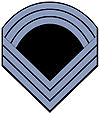
The first official U.S. use of the term was in 1776, when a Sergeant Major (SGM) was appointed to the headquarters of each infantry battalion of the Continental Army. However, there appears to be no recorded history of what was worn to denote the rank. Chevrons to denote rank did not appear in the U.S. Army until 1817,after cadets at the U.S. Military Academy at West Point, N.Y. wore them point down on their sleeves until 1902 when they were changed to points up. |
|
In 1920, with the standardization of the army's enlisted pay grades, Sergeant Major ceased to be a title of rank or grade. |
|
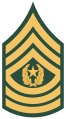
The rank was re-introduced in 1958 when Congress authorized the E-8 and E-9 pay grades. With the advent of the rank of Sergeant Major of the Army, the rank of E9 was denoted as a Command Sergeant Major and received a separate chevron. The administrative position, Command Sergeant Major (CSM), is the senior enlisted advisor to the commanding officer and carries with it certain ceremonial functions such as caring for the unit's colors. Additionally, they serve as monitors for, and advocates of, the enlisted men in the command. This position exists in units of battalion size and larger. |
|
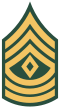
The senior Noncommissioned Officer (NCO) of a headquarters unit at battalion should carry the rank of Sergeant Major, but personnel shortages may from time- to-time, force this position to be held by a senior First Sergeant (1SG). |
|
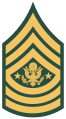
The appointment of Sergeant Major of the Army was created on 4 July 1966. In 1979 the center of the chevron changed to two stars until 1994 when it was again changed. The current chevron is still currently in use. |
|
|
|
|
Use Your Browser Button To Return |