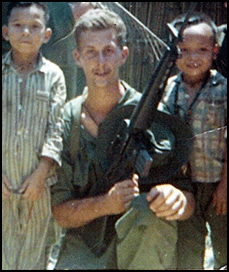
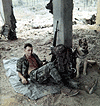
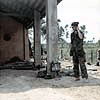
20 March PFC Thomas T. Watson is assigned to duty at the outpost and he was followed within a week by PFC David J. "Ski" Sinwelski which increased the MP staff to five, 1 Noncommissioned Officer and 4 enlisted men.
“Several days earlier I arrived in Vietnam after a thirty day leave at home following an eleven month tour with the 2nd MP Company, 2nd Infantry Division along the Demilitarized Zone in South Korea. On the morning or 20 March 1968, a dusty jeep picked me up at the 90th Replacement Battalion and we traveled for several minutes to Long Binh Post next door. I couldn't help but notice that there wasn't much change in appearance between the replacement battalion compound and Long Binh Post. There was no jungle, no trees, only the smell of diesel fuel and plenty of dust.
The jeep dropped me off at the B Company Orderly Room and left with the other two passengers, I think they were destined for A Company. I went inside the Orderly Room to deliver my orders and meet the Commanding Officer. I introduced myself to the company clerk who introduced me to the Captain, who was busy at his desk with some paperwork and introduced me to the First Sergeant, who shook my hand and immediately reintroduced me to the company clerk before leaving.
I asked the company clerk about drawing some emergency pay because I was down to my last dollar, he informed me that my 201-file had not arrived yet so that was out of the question, but he added, "not to worry...it would follow along shortly." It seems the Personnel File jinx I am cursed with followed me to Vietnam. This was the third time my 201-file didn’t keep up with me during reassignment. The first occurred from basic at Fort Dix, New Jersey to MP school at Fort Gordon, then from MP school to Fort Lewis Washington and South Korea, and now from Korea to Vietnam. At least this time I still had my duffel bag with my uniforms unlike at my arrival at Fort Lewis when I learned my baggage was put on the wrong aircraft and didn't catch up with me for a week. But no records means no pay to hold me over, and I was down to my last dollar.
The clerk directed me to supply while he processed my paperwork. At supply I was informed they didn’t have any jungle fatigues or jungle boots in my size, and didn’t know when they would. I was issued a steel pot, poncho, web belt with two ammo pouches, a field dressing, bayonet and canteen. From supply I went to the arms room for a weapon and was issued an M-14 with one magazine, and when I asked about an M-16 I got a funny look and was told there were none available.
I returned to the Orderly Room to get my barracks and duty assignment. The company clerk was still hard at work on his typewriter, and didn't look up or miss a keystroke when he told me I was assigned to duty at Outpost-2. There was no explanation bunk or locker, and he told me not to unpack my bag and to just hang around the company area. With his full attention still focused on the typewriter, he instructed me to report to the Orderly Room just before dark with my duffel bag, and I would be transported to my duty assignment at Outpost-2 by one of the ambush teams. It was then that I began to wonder just what the hell I had gotten myself into... MP ambush teams?
I stepped outside into the hot sun and faced an empty open field. I had several hours to kill, no money and no idea what to do with myself until dark. To my right was a row of aluminum buildings (Adam's Huts) used as barracks where I noticed the one at the far end had its door open, and that's where I headed. I stepped inside and found several members of the company sitting around on the bunks shooting the bull, and playing cards on a footlocker. I sat down on an open bunk and introduced myself, and as expected I went through the usual new guy interrogation. They asked the standard questions, where you from in the states, where were you stationed, what's your assignment? They were all openly friendly and I now felt comfortable for the first time. Being the new guy and asking someone for a loan on you first day can be like a kiss of death, but I was desperate not knowing when my orders would catch up with me. Fortunately my luck was changing and I never had to ask. I was invited to join the poker game and now had my opening to explain my financial problem. When I told them my 201-file was lost in transit and I was short on supplies and pocket money, one of them offered me a twenty until payday. His name was "Trappe,” and they were all "River Rats" from the boat squad.
They told me about the river patrol unit, ambush teams, convoy escort to a place called Tay Ninh, and outpost duty. They all laughed when I told them about my assignment to outpost duty, and that worried me. I stayed watching the card game and before they left I obtained directions to the PX to stock up on razor blades, toothpaste and cigarettes.
Just after dark I met the ambush team in front of the Orderly Room, a seven-man squad with a buck sergeant in charge. They were all dressed in jungle fatigues, boonie hats, and field web gear. Not what I was used to seeing at a standard line duty guard-mount inspection.
We all climbed into a 3/4 ton truck for the ride off Long Binh Post to a place they referred to as the TAOR (Tactical Area Of Responsibility). The truck proceeded out of one of the main gates, turned left and traveled several miles along a two lane paved highway. To our left I could see the lights of Long Binh Post and the many bunkers and observation towers that lined the perimeter, and to our right was total darkness. The trip took approximately ten to fifteen minutes before the truck turned right onto a small dirt road. With the light from the post perimeter I could faintly see a village looming off in the distance where the dirt roadway faded into the darkness. The driver turned off the headlights and stopped just off the paved roadway where we dismounted. The squad leaders instructions were short and to the point, I was to stay near the back of the squad, keep my mouth shut and to follow the movements of the man in front of me. As we started off on foot into the darkness in a single file, the feel of the M14 rifle I was issued became very comforting.
As we approached the edge of the village a signal was given to stop. I could hear the radio operator (RTO) in a whispered voice notifying a local outpost that we were approaching on foot, and his request that they inform their sentries. A few minutes later we proceeded into the village past the outpost. It was very dark that night and after we passed by the outpost it appeared that we were entering into a long dark tunnel. I couldn’t see much due to the darkness, and there was only an occasional faint light every now and then from small oil lamps inside some of the village homes. It was a long, slow, straight walk.
After a few hundred yards we came to a bend in the main road to the right and stopped. The point man shouted in English "MP-GI" towards a building on the other side of the roadway, and a Vietnamese replied in broken English…"OK-MP." After a brief wait we continued on. I asked the man to my front what had occurred, and he said that we were passing the National Police Station and wanted to alert the sentries because there were no U.S. troops working there.
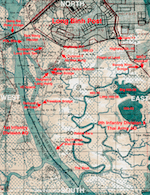
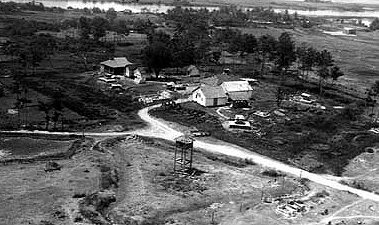
The smells and what few outlines I could make out in the dark were not unlike the many rural villages I patrolled on foot at night in South Korea. The difference being that in these villages there was no one outside, you heard no music, and gone were the voices of adults and children. Shortly after passing the National Police Station we turned left came to a large metal bridge that crossed what appeared to be a wide canal. The squad stopped, watched, and listened for several minutes before moving on. They were especially cautious at the bridge. As quiet as we were, the sound of our footsteps on the steel deck of the bridge could still be heard for some distance. Approximately one hundred yards beyond the bridge the buildings ended, and the road wound through a large expanse of what appeared to be forest to our left and open rice paddies to our right. It was still dark and overcast, and hard to see very far beyond the sides of the dirt roadway. My vision was restricted to outlines and shadows, some darker than others, which allowed me some perception of distance. After proceeding several hundred yards, I could make out some faint lights and the outline of several trees and small buildings in the distance to our right past some rice paddies. It was my first view of Outpost-2.
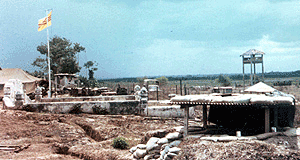
As we approached the outpost we stopped again at a right turn bend in the roadway where the RTO contacted the MPs inside alerting them to our approach. Once again we waited several minutes before proceeding on. The squad next stopped at a small barbed wire gate on the perimeter of the outpost. A Vietnamese soldier in fatigues with a WWII era M2 Carbine strapped over his shoulder opened the gate and directed us inside. We walked past sandbag bunkers on which several other Vietnamese soldiers were sitting with their weapons across their laps while smoking cigarettes in the dark. Once inside the compound area I was introduced to SGT Robert R. "Andy" Anderson (age-20 from Pennsylvania) the outpost military police squad leader, and my new boss. The ambush team squad leader talked with SGT Anderson briefly about VC activity, and after giving his men a short smoke break, back out into the darkness they walked
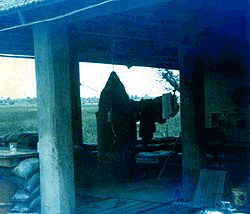
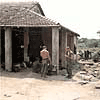
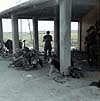
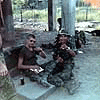
It was after 2400 hours, still very dark, and I couldn’t see very much of what was around me, just the outlines of the bunkers and buildings. The only lights they had were a couple of small oil lamps and lanterns, and I felt like I was at Valley Forge with Washington’s Army. SGT Anderson walked me around the center of the compound so I could get some idea of its layout. During the walk he explained that they were trying to get a new generator for perimeter lights that surround the OP, and also hoped to obtain one more man for the squad, which at this time numbered four MPs, including me. SGT Anderson said our primary mission was to provide protection to the local village of Long Hung, and added that they were well liked by most of the local villagers. He also explained that approximately fifteen to twenty Popular Forces (PF) soldiers equivalent to our local National Guard who lived in the village, also manned the outpost. Our sister outpost, OP-1, was located approximately one klick (1000 meters) to the south, just outside another village called An Xuan. SGT Anderson explained that the company refers to them as the "Cowboys from OP-2" because they’re very self-sufficient. I thought to myself that with what I just went through on post you would have to be, just to survive. I was introduced to the other two members of the MP team, a PFC who liked to be called "Junior" or "JR" (age-19 from Georgia), and another PFC named Hush (age-19 from Kansas).
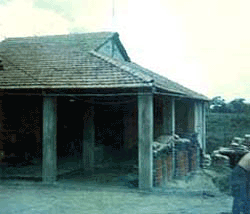
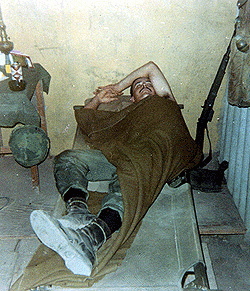
Due to their manpower situation I was immediately assigned a shift on the radio watch. My bed for the night, and the next several months, was an old Army issue cot located in the main pavilion with the other team members. After the introduction and brief orientation I was free to sleep until my radio watch. My adrenaline was pumping big time and there was no way I was going to be able to close my eyes until it wore off, so I traded my shift for the current one, and made myself at home by the radio. I sat in a chair next to the small wooden table containing a small oil lamp, the radio and a crank field phone. It was quiet and I began to relax taking in all the sounds and smells of the night. The small oil lamp on the table gave off enough light, so I figured this was as good a time as any to write a letter.
I'm not sure exactly how much time had passed, but I was still writing the letter when the night came alive with the sounds of automatic rifle fire and excited voices over the radio. Tracers were flying wildly through the night sky in the distance at Outpost-1. Within seconds the rest of the crew was up, armed, and at the ready. There was a exchange of gunfire between some VC and one of the ambush teams somewhere between OP-2 and OP-1. According to the radio traffic no one in the ambush team was wounded, and they didn't find any VC casualties. I though to myself, how nice of them to provide a fireworks display to welcome me to B Company and MP duty In Vietnam. We spent the rest of the morning on full 100% alert until daylight arrived.” CPL Thomas T. Watson, B Company.

 If you recognize or participated in any of the events listed on this page and would like to contribute information, personal stories, or photographs, please use the Email Link above.
 18th Bde.
  89th Group
  720th
720th




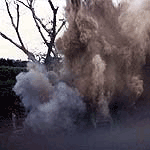
 12 June A Viet Cong land mine destroyed a 3/4 ton dump truck being used by D Company, 46th Engineer Battalion constructing the new Friendship Bridge's. The land mine was placed under the single lane dirt roadway between outpost #1 and #2. The front end of the 3/4 ton dump truck was destroyed but the driver received only minor injuries.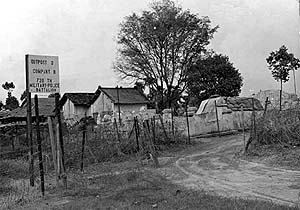
 25th
25th