Drug Suppression Team (DST) ~ 720th Military Police Battalion Reunion Association ~ Vietnam History Project ~ This Page Last Updated 21 September 2008
|
|
1971 |
To counter a growing drug abuse problem in Vietnam that mushroomed from late 1969 into the Vietnamization phase of the war through the early 1970's, the Army established an amnesty program and broadened their enforcement program. During 1971 through January 1972, the 720th Military Police Battalion formed a Drug Suppression Team (DST), that was composed of approximately fifteen members of the Battalion, and specialized in the covert investigation of drug related crimes in the III and IV Corps Tactical Zones. |
19 September 1LT John D. Bradley, II, was assigned as OIC of the unit. They used the 11th Armored Cavalry Regiment as their cover unit. |
|
|
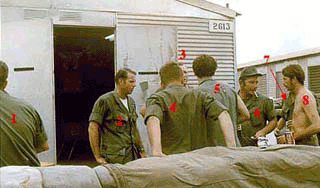
The unit was covertly housed at the Plantation Area located between Long Binh Post and Bien Hoa City. 1LT John D. Bradley, II, was the Officer In Charge (OIC), and SGT Larry Newton was the ranking Noncommissioned Officer In Charge, (NCOIC). The unit used M151 Jeeps as their primary mode of transportation. |
|
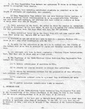
The Standard Operating Procedures (SOP) were written by 1LT Bradley. click on each page > |
The SOP defined their mission to identify sources of illicit narcotics trafficking, conduct covert investigations, infiltrate when possible, identify the participants, and develop the necessary evidence to make arrests and seizures. The unit also worked extensively with the Joint Narcotics Investigative Division (JNID) . The JNID was made up primarily of Criminal Investigation Division (CID) men that were working narcotics, and members of the DST. If and when the DST developed evidence of criminal activity involving Vietnamese nationals or military, they involved the Vietnamese National Police (Canh Sat) or Vietnamese Military Police (Quan Canh) in their closing phases of the investigation, to execute arrest, and perform search and seizures. |
10 September The DST had a very productive and successful record during its existence. In one example, the DST infiltrated the 169th US Army Engineer Battalion at Phoung Lam. |
|
The base called "The Castle In The Sky," was located about 70 miles north-northwest of Saigon, where drug trafficking and abuse complaints became excessive. Prior coordination of the operation was assisted by the commanding officer of the battalion. |
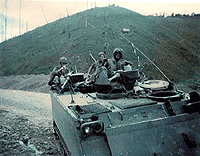
Team members successfully infiltrated B Company posing as a security force for the 11th Armored Cavalry Regiment. To do this they used Armored Personnel Carriers (APC's) from Company C of the 720th MP Battalion to perfect their cover. They were able to make undercover purchases of marijuana and heroin, identify the main drug dealers within the unit, and successfully conclude their investigation on 10 September 1971 with arrest and seizures of narcotics. A total of 43 suspects were apprehended and their quarters were searched and the following drugs were seized. |
|
||||||||||||||||||||
A total of 26 personnel were apprehended for marijuana violations and a total of 17 personnel were apprehended for heroin violations. The 43 suspects were transported to Long Binh Post where local assistance was obtained and formal questioning conducted. Of the 17 suspects apprehended for use and/or possession of heroin, 7 were the subject of a positive urinalysis test. The initial military police reports were prepared and distributed within 24 hours subsequent to apprehension. The narcotics and marijuana were relinquished to the 8th Military Police Group Criminal Investigation Division (CID) laboratory for analysis. The results were all positive. A 10 acre marijuana field was also located by the DST. |
October Another major operation in the Vung Tau area resulted in arrests of numerous Vietnamese Nationals who were operating a black market scheme through the Australian Post Exchange (PX), story follows. |
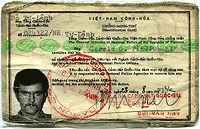
"We Don't Need No Stinkin' Ration Card" It was October 1971 and the 720th MP Battalion's Drug Suppression Team was involved in the investigation of a large black market operation run out of Vung Tau. Although the DST was primarily focused on narcotics, the situation which existed in Vung Tau was too good to pass by. SGT Gerald Huffner (now deceased) and SP/4 Charles Valrie (A Company), posing as corrupt soldiers who wanted to make a buck, infiltrated a Vietnamese organization which specialized in large rationed Post Exchange (PX) items. These were primarily stereo systems, tape decks and speakers. The target was the Australian PX located in Vung Tau, which was staffed by numerous Vietnamese locals, including associates of the blackmarketeers. Huffner and Valrie, after befriending the leader of the organization, were given cash by the leader and told to give the sales clerk a pre-determined hand signal. No ration card necessary. The stereo equipment was then taken back to the leaders residence, where Huffner and Valrie would exchange the equipment for a "commission." These items were then sold on the open market by the Vietnamese. This process continued for more than a month. The undercover MP's decided they did not want cash payment, but heroin instead. Also, the Vietnamese leader wanted a pallet of beer dropped in his neighborhood for the locals. After substantial red tape through headquarters, the beer was trucked from Long Binh to Vung Tau and delivered to the previously agreed on location. Also, one kilo of heroin was given to the undercover MP's as payment for their efforts in obtaining the stereo equipment. As soon as the narcotic transaction was completed, the leaders of the black market organization was arrested and taken away. The Vietnamese National Police making the arrest were notified just prior to the arrest for security reason. The 144 cases of beer were gone in five minutes. The heroin was secured and the members of the Drug Suppression Team, including myself, left town as soon as possible. I never found out what happened to the Vietnamese black marketers, but most likely they bought their way out of any potential problems. I did hear rumors about death threats against Huffner and Valrie from 720th personnel working in Vung Tau. That is the reason we never returned. 1LT John D. Bradley, II, HQ Detachment, DST Supervisor, 720th MP Battalion, 89th MP Group, 18th MP Brigade, September 1971 to September 1972. |

The team continued to compile an impressive number of successful investigations until it was finally disbanded sometime after January of 1972. |
Drug Suppression Team Statistics for Seizures and Arrest from 1 March 1971 to 3 January 1972 |
Heroin 95 to 98% purity compared to 5% purity in the US at that time. Marijuana 3,588 cigarettes $13,050 US and $2,000.00 Vietnamese
|
Arrest Total of 149 Persons arrested Investigations were conducted in the following areas of III and IV Corps during this time period. Saigon, Phu Lam, Xuan Loc, Bien Hoa, Ho Nia, Can Tho, Vin Long, Di An, Long Thanh, Tan An, Ben Cat, Lai Khe, Phu Loi, Long Binh, Tay Ninh, Cu Chi, Vung Tau, Trang Bang, Bearcat, and Fire Support Base Mace.
|
1971 |
20 December When the 89th MP Group departed Vietnam and was inactivated, the 720th MP Battalion was then attached to the 8th Military Police Group (Criminal Investigation) also located at Long Binh Post. |
|
|
1972 |
The drug investigations continued within the III and IV Military Regions until the 720th was deactivated and left Vietnam on 13 August 1972. Some of the the MPs that were still assigned to the verious drug units asked for reassignment under a Temporary Duty transfer (TDY) to the Joint Narcotics Investigation Division (JNID) for the Saigon Military District, under the jurisdiction of the 8th MP Group CID. When the 720th was deactivated and departed Vietnam the members of the battalion that were not eligible to return to the US remained assigned to the JNID. The HQ for JNID, was the former Senior Noncommissioned Officers (NCO) Bachelor Enlisted Quarters (BEQ), at 150 Yen Do Street, in Saigon. It was a Large French Villa. |
The unit was one of a kind, answered to very few, and had a Major as their commanding officer, with Warrant Officers at the mid Level. Criminal Investigation Agents (CID) Military Police Investigators (MPI) doing the street work. Their work targeted only the major drug distributors, 100 pounds of marijuana or 1 Kilo (1,000 grams or approximately 2.2 pounds) of Heroin. |
|
Use Your Browser Button
To Return |