![]() |
~ Regional Forces Popular Forces ~ South Vietnamese Army ~~ 720th MP Battalion Reunion Association Vietnam History Project ~~ |
![]() |
If you would like to contribute any information, documents, personal stories or photographs pertaining to the PF's that you worked with, please notify the History Project Manager via the above Email Link. |
| History of the Regional
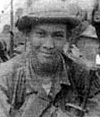
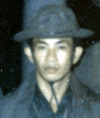
Forces / Popular Forces (RF/PF) Regional Forces and Popular Forces, or "Rough Puffs" and "PF's" (RF/PF), as they were often called, fought a major share of the War in Vietnam at the rice-roots level. Comprising about 50% of the Republic of Vietnam Armed Forces, they operated in all the provinces by the end of the war. During the height of the war more than 3,000 PF (Popular Forces) platoons defended villages and hamlets, guarded key installations and provided security for officials. Better than 800 Regional Force companies performed the same type of duty at the district level. The overall effectiveness of these soldiers was solidly established. And the bravery of many RF/PF units became legendary. The Regional Forces were recruited locally and operated under the Vietnamese province (sector) chief or the district (sub-sector) chief. The Popular Forces were recruited at village level, operated under NCOs (Noncommissioned Officers) responsible to the village chief, and local ARVN (Army of The Republic of Vietnam) district chief, and were normally employed only in the local area. The RF/PF were volunteer organizations, forbidden to recruit draft-age personnel. The operated their own training centers and had quotas to fill for ARVN schools and centers. Logistical support was provided by an ARVN supported administrative and direct support logistical company assigned to each sector.
The shortage and the age of weapons prevented many of the local PF units from being properly armed. They were not allowed to take the weapons from their outpost. The weapons would turned over to their relief when their shift ended and they ventured back out into the local village. In the event of a full scale call to duty the shortage would have been critical. After large US Infantry units were withdrawn under the Vietnamization program, more modern weapons filtered down to the local PF forces. The RF light infantry company had approximately 123 men, its heaviest weapon was the 60mm mortar. In addition, 24 river boat companies in III and IV Corps area were used for movement of troops and supplies and for medical evacuation missions.
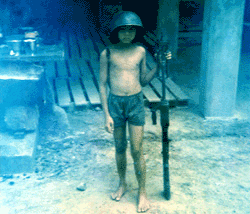
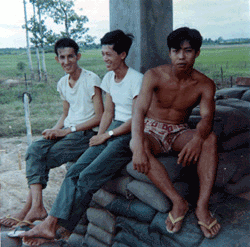
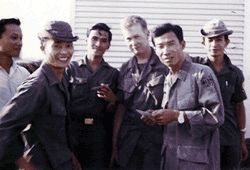
Many of the local PFs served during their off duty time worked their small piece of land during the day and returned to spend the night in the outpost. Most if not all of the PFs that worked within the 720th TAOR had ARVN issued green military fatigues for uniforms. However, it was not unusual to see them on occasion shed the issued clothing for civilian clothes once they were at home. American advisors to the RF/PF were assigned at national, corps, division and province level. Many RF/PFs were assigned to work directly attached to local U.S. Forces as scouts, guides and interpreters . In the 720th MP Battalion Tactical Area Of Responsibility (TAOR), American MPs were assigned to each of the four RF/PF village outpost to assist with village security and civic action programs. In the initial stages of Operation STABILIZE when the 720th TAOR was first established the trust factor between the local RF/PF's and the US MP's was almost non existent. Many of the US MP's felt the PF's were not to be trusted and that they were communist sympathizers. This was primarily based on the fact that the PF's were local and the four primary villages with the TAOR were ripe with VC activity before Operation STABILIZE. On 15 October a 21 man PF Platoon lead by SGT Huynh Van Hai was attached to the 720th MP Battalion's B Company Platoon assigned to the TAOR and commanded by 2LT Robert S. Wilkerson. As time went by the MP's eventually gained a respect for SGT Huynh and many of the PF's. The respect and trust continued to grow as MP's eventually moved into the PF outpost in the TAOR and lived and worked with them daily. Notwithstanding all the shortcomings of their unit makeup, and armament capabilities, most were valuable conduits of intelligence from the local villagers, and many were brave beyond a fault when having to defend their homes and families from local Viet Cong (VC) and North Vietnamese Army (NVA) aggression. The PFs were found to be a valuable asset when assigned to the MP ambush and reconnaissance teams. Their knowledge of the back rivers and trails outside the villages in which the grew up in often proved the difference between identifying the false identification documents being carried by a Viet Cong suspect or coming up empty handed. They also obtained valuable information from their neighbors in the village.
The cream of the RF/PF staff of the rank of Sergeant down were normally the men selected to work in the often coveted positions of MP unit scouts, guides and interpreters. The ability to speak and understand American language, at least in a limited capacity, was also a must. As the years passed the caliber of training, education, and weaponry of the PF's assigned to assist the Battalion greatly improved.
There were even instances where the MP’s tried, although unsuccessfully, to obtain authorization for their PF to go on out of country rest & relaxation (R&R) leave with them.
|
|
Use Your Browser
Button To Return |