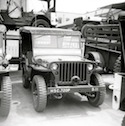
1941 4x4 |
Command Reconnaissance Truck |
Later Nicknamed by GI's as the "Jeep" |

|
~ 720th Military Police Battalion History Project ~ |
|
|
|
1942 ~ 1955 World War II & Tokyo, Occupied Japan |
From 1932 through 1940 the U.S. Army flirted with several ideas for a small vehicle for military purposes. The ideas ranged from a small automobile to a lightweight reconnaissance car, mobile machine gun and personnel carrier, back to the lightweight automobile to replace the motorcycle. It was peacetime, the military was downsized and of little interest to Congress after WWI, so none of the ideas received the necessary interest or funding and were soon dropped. It wasn't until February 1940 with the war in Europe looming that the Army got serious and formed a special committee to research specifications for "Light Vehicle Development." |
The leading competitors by October 1940 were: The American Bantam Car Company of Butler, PA, with the Bantam "Pilot," many Jeep historians designate this as the first and original Jeep design; The Willys-Overland "Ouad;" The Ford Motor Company "Pigmy." |
1941 After numerous specification and design changes, all three companies were given contracts to produce the vehicle known then as the 1/4 ton (4x4) light reconnaissance truck or the 1/4 ton (4x4) Command Reconnaissance truck, depending on who's history you follow. The name Jeep had yet to be attached to the vehicle and also had as tumultuous a history as the argument over the original vehicle design, bids, and contract awards. |
The Willy's and Ford prototypes where tested, changes made and 1,500 each of the Bantam MK II, Willys MA, and Ford GP were produced. After several civil suits and a Congressional Hearing into the procurement process, the vehicle later to be called the "Jeep," finally came into being and is recognized as one of the most important vehicles in U.S. Military History. |
1942
|
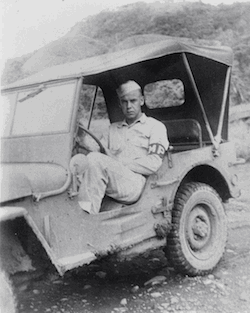
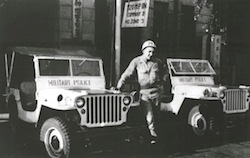
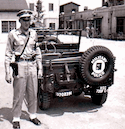
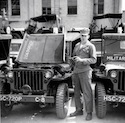
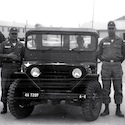
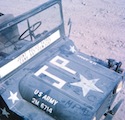
1941 Willis MB Slat Grill, 4x4 Reconnaissance Truck was the earliest known Jeep utilized by the 720th MP Battalion (photo left). Only several hundred thousand were manufactured and today only 6 are known to exist. Willis M38A1 Round Fender was manufactured for the military from 1952 through 1957. It was eventually replaced by the Ford M151.
|
|
|
|
|
|
1951 |
1951 |
1951 |
1955 |
1961 |
|
1965 |
1966 ~ 1972 The Vietnam War |
. |
"The MP's in Vietnam depended on their Jeeps like the Cavalry of old depended on their horses!" |
. |
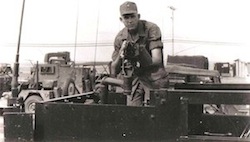
When the 720th MP Battalion first arrived in Vietnam on 19 October 1966, it was authorized by TO&E 116- 1/4 ton truck cargo (Jeep) each with one AN/VRC-46 radio and only nine M60 machine-guns with pedestal mounts. |
. |
The Ford M151 1/4 ton truck was designed with guidance from the U.S. Army's Ordnance Truck Automotive Command (OTAC) and development work began in 1951. |
Various types of experimental and pilot vehicles were developed and evaluated, including separate chassis/body combinations, aluminum vehicles, solid-axle versions etc. |
|
The final version accepted by OTAC was an integral chassis/body (monocoque) unit, with all-round independent suspension, 24-volt waterproofed electrical system, two/four-wheel drive, with a four-speed, single transfer transmission. The first contract was awarded to Ford and vehicles were issued to the Military in 1960 (Model M151). The M151A1 was a revised version designed in 1963/64. It featured a heavier-duty rear suspension, designed to cope with add-on weapons and extra loads, which had caused problems for the suspension of the basic M151. Delivery commenced in 1964 and continued up to 1969, with vehicles being built by both Ford and Willis (later Kaiser). |
. |
The independent rear suspension configuration of the M151 and A1 models gave rise to an over-steer condition and this, together with a lack of body "tilt" on cornering, led to many accidents, where the vehicle abruptly went out of control and/or rolled over when sudden steering movements were made. Despite training courses, films, circulars and pamphlets, the vehicle gained a reputation as being unstable, and efforts were made to "design out" the handling problems. On 31 January 1967 With ever increasing convoy escort security demands the Battalion Commander, LTC Glenn A. Hill, submitted a request to higher headquarters to increase the battalion TO&E of 1/4 ton trucks (Jeeps), radios, and M60 Machine-guns with pedestal mounts to meet their current missions needs and attrition rates. Early Battalion Operation Reports/Lessons Learned for each quarter reveal that the weather, roadway conditions, and running time, severely effected the life of the Jeeps. Initial problems developed with carburetors, radiator's, fender cracking with the use of whip antennas, and battery life. All were passed up the chain of command to eventually be addressed by the Department of Defense, however, many more were remedied by the mechanics at the motor pool with resourceful and imaginative emergency customization. The 720th MP Battalion utilized three versions of the Jeep for it's patrol, highway security, general escort, and convoy escort missions. |
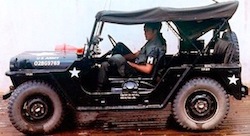
The Rag Top Patrol Jeep |
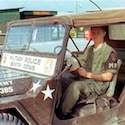
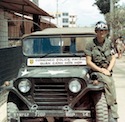
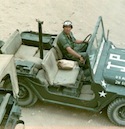
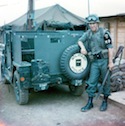
The standard stock version was used for transportation, interior post patrol and limited distance exterior post patrols and checkpoint duty. The crew normally consisted of two MP's and/or a Quan Canh (ARVN MP) or Can Sat (National Policeman) armed with .45 caliber M1911 side arms and M14 or M16 rifles. |
. |
The patrol Jeeps were also fitted with red emergency light and a siren, and as the years pasted the style, size and placement of the emergency lights and sirens would change. |
|
|
1969 |
1971 |
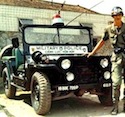
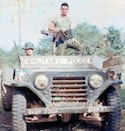
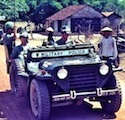
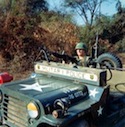
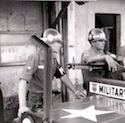
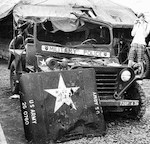
In addition to the regulation vehicle identification bumper markings, standard vehicle identification signs written in English of "Military Police" with the units shoulder patch on each end or a patch and unit logo were displayed below the windshield, and depending on the unit and the duties being performed you could also expect to see many variations. The 212th used the 18th MP Brigade patch on one side with the logo of a German Shepard's head on the other. |
. |
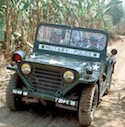
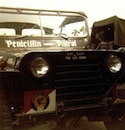
Almost all were in dual English and Vietnamese from "Combined" Patrols to "Joint" Patrols which sometimes also had the ARVN MP shoulder patch, and at the Can Tho Detachment there was one that read "Penicillin Patrol" that was used exclusively by the Provost Marshal Medical Team. |
|
|
|
|
|
|
The Gun Jeep |
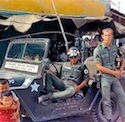
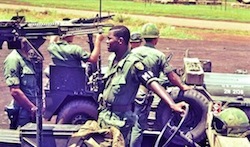
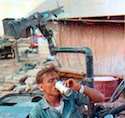
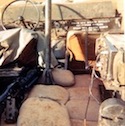
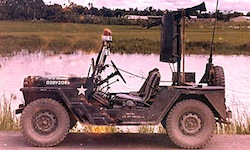
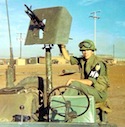
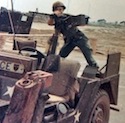
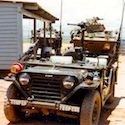
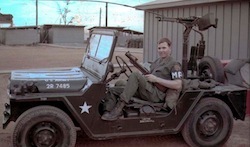
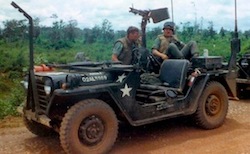
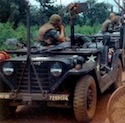
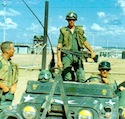
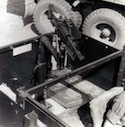
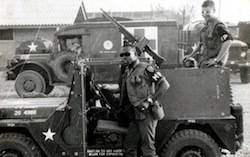
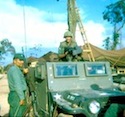
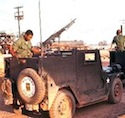
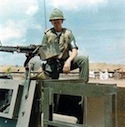
Used for exterior post highway security, general escort, and convoy escort duty. The rag top was removed, a pedestal mounted M60 Machine-gun added, and in most instances sandbags were added to a box on the dash and floor for additional small arms and land mine protection. There were no doors or other protective cover for the occupants. |
. |
Depending on the mission two or three MP's crewed the vehicle wearing steel helmets and (WW-II) flack vests, armed with .45 caliber M1911 sidearms, M14 or 16 rifles, M60 Machine-gun and on occasion an M79 40mm Grenade Launcher. |
. |
One concentrated on driving, the front passenger handled all radio communications and the rear passenger was the gunner. |
Some crews who were assigned a specific mission that used the same jeep daily would also paint a name on the front. |
|
|
|
|
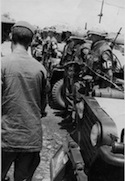
Individual field modifications authorized by company commanders and performed by ingenious unit MP's, motor pool staff and armorer's as to weaponry, seats & covers, ammo storage compartments, fuel can and tire mounts, and gun shields were not unusual and often done to fit the needs of specific convoy escort missions or for the safety and comfort of the crew. |
. |
There were two basic pedestal mounts for the machine-guns. One was a straight neck and the other a goose neck. Some were modified in height. Regardless of which one was installed, the rear gunner was still fully exposed when operating the machine-gun. |
|
|
|
|
|
|
|
|
| Wire Cutters |
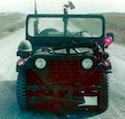
Another field modification that disappeared from most jeeps after a few years was the angle iron post welded to the front bumper and designed to cut taunt-wire traps strung across the roadway by the enemy hoping to decapitate the front seat passengers. Each company conducting convoy escort or night patrols in the more remote roadways had one or two jeeps with the wire cutter attached. |
. |
The item was not part of the Army inventory so all of them were field manufactured by the units. Other units that conducted night patrols in urban areas also used them. During the convoy runs the lead Scout jeep was usually equipped with one. As the roadway shoulders were cleared back on most of the main convoy routes the need for the wire cutters diminished. |
. |
|
|
|
|
The Armored Gun Jeep |
|
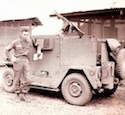
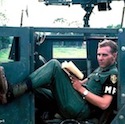
Used for exterior post highway security, general escort, and convoy escort duty. The armored gun jeep was manned by three MP's. Each performed the same functions as the gun jeep crews and were armed with the same weapons. When the Battalion first arrived in Vietnam their Jeeps didn’t have the armored crew compartment kits for protection against enemy small arms fire. The kits would arrive and be installed later that year, and the demand quickly out paced the inventory requiring Brigade to order the manufacture of some kits through local contractors. That often resulted in a poor quality product. The kits consisted of the standard package crew compartment protection with doors and ballistics glass inserts. Ballistics glass was still in its early stages of development and consisted of multiple layers of a composite polymer plastic pressed together to provide the needed thickness for protection. Unfortunately, the inserts were so thick they badly distorted the view from the interior of the jeep. They also restricted the flow of air through open gun ports that cooled the inside of the compartment in the heat of the day. |
. |
Add to that the dust and grit hitting them and exposure to the heat and humidity, causing them to scratch the outer layer of polymer plastic and cloud up quickly so you couldn't see through them at all. Contrary to standard operating procedures, many of the crews that used the armored gun jeeps would take the ballistic windows out of the slots after guard mount and pile them on the back floor of the jeep. This practice was frowned upon by the command and constant efforts were made to remind the crew members to keep the glass panels in during the convoy escorts and highway security patrols There was even a ballistic window with an enemy small arms round embedded in it on display in the mess hall with a reminder of what could happen without the windows. The MP's were not deterred, they found it was much safer to be able to see the enemy through a small open slit rather than stick their heads up over the armor sides because the ballistics glass was clouded. |
|
. |
On 19 August 1967 CPL Robert Earl Clowe, age 22, and SP/4 Wallace Michael Jackson, age 20, were killed by close in enemy small arms and heavy caliber weapons fire as their Rag Top patrol jeep left the A Company Tay Ninh Detachment compound. On 21 August 1967 an inspection of their jeep was conducted by MAJ Kenneth B. Stinson, USA WDMERT [acronym has yet to be identified], from MACV in Saigon. The Battalion Daily Log of that day stated MAJ Stinson said he was testing the materials to determine the types of weapons and distance of the the jeep from the ambush positions when it was fired upon. 1LT Gordon L. Locke of A Company was assigned to assist MAJ Stinson in obtaining the pictures and materials requested. Editors Notes: Based on information the History Project has obtained through interviews and official documents, it appears that the inspection was part of an ongoing program for the development and testing of ballistics glass for vehicle windshields. The end result of that program or if it was ever completed was not mentioned in later Brigade, Group or Battalion quarterly reports. |
|
|
|
|
|
|
|
|
|
The kit was the only answer to small arms fire that was available at the time. The armor protection was only effective to stop small arms and ground blasts grenade or 60mm mortar fragments. To effectively fire the M60 the gunner had to stand or crouch in an upright position exposing himself above the compartment top. And since there was no top on the compartment, the enemy quickly learned to control the release of their grenades for air burst detonation. The fragments would ricochet around the compartment interior causing even more casualties. |
. |
The added weight to the jeep frame, transmission and tires greatly reduced the vehicles service life which created the additional problems in obtaining new replacement jeeps which were always in short supply. |
The Two Alternatives |
Brigade casualties were still high and they began searching for a better defense hardened vehicle with higher firepower for convoy escort and highway security missions. Just before the February 1968 Tet Offensive the M117 Armored Personnel Carriers (APC) arrived in the Brigade inventory, soon to be followed by the newly developed Cadillac Gage M706 V100 Armored Commando Car (V100). Both also had their problems. The M113 APC's, already in the MACV inventory, were prioritized for U.S. and ARVN combat arms units and their rerouting resulted in a lack of radios, spare parts, weapons systems, trained mechanics and training NCO's that were abundantly available in the combat arms units. Modified TO&E's had to be quickly submitted by Brigade. The V100's, originally in the planning and development phase in the early 1960's, had been cancelled by the Department Of Defense (DOD) just before the buildup. Although the older model Army M108 Armored Reconnaissance Car successfully met the operational needs of the military police in Korea, they believed the Army no longer had a need for them. Fortunately for Brigade, the V100's already manufactured were being shipped to Vietnam for turn over to the ARVN Army, and only had to be rerouted through MACV. However, they lacked radios, weapons systems, trained mechanics and the initial maintenance and training manuals were all printed in Vietnamese, so that created another problem until new manuals could be provided. Never the less, the military police quickly learned to adapt and improvise, and both vehicles quickly replaced the armored gun jeep as the vehicle of choice for Brigade convoy and highway security missions, and within a year the armored kits for the gun jeeps disappeared from Brigade unit inventories. |
. |
It was a situation where the old WW-II & Korean War technology, tactics and lack of DOD foresight in counterinsurgency style warfare had yet to catch up with the Vietnam War's new non-linear battlefield mission requirements. |
. |
1975 - 1983 Post Vietnam Era, Fort Hood, Texas |
|
The Jeep was the dependable and popular workhorse of the U.S. Army vehicle fleet from February 1941 through March 1983 when it was finally replaced by the HMMWV or High Mobility Multipurpose Wheeled Vehicles. |